
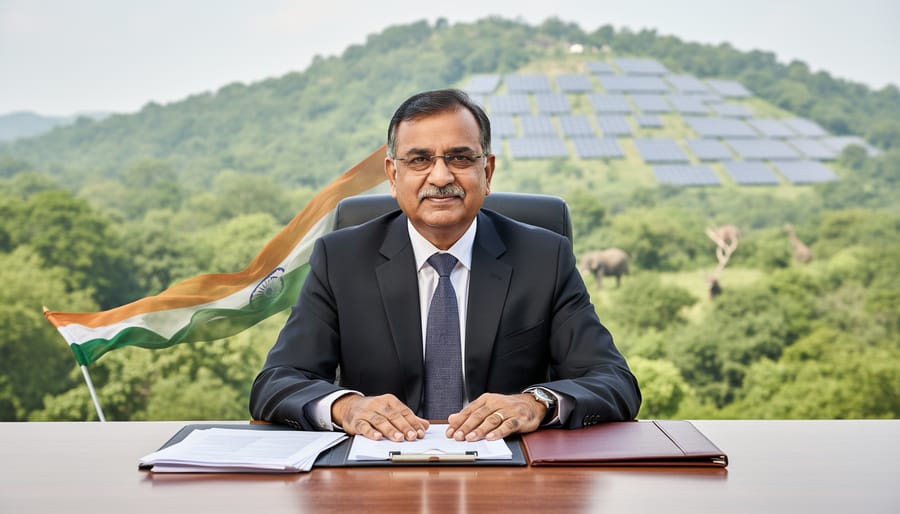


Shri Bhupender Yadav currently serves as India’s Minister of Environment, Forest and Climate Change, leading the world’s most populous nation through a critical period of balancing economic growth with environmental protection. This position places him at the center of global climate negotiations, responsible for shaping policies that affect not only India’s 1.4 billion citizens but also international efforts to limit warming and preserve biodiversity.
Understanding who holds this portfolio matters because India’s environmental decisions ripple across continents. As the third-largest carbon emitter and a renewable energy powerhouse simultaneously pursuing ambitious solar targets and managing vast forest resources, India’s climate policy influences global markets, investment flows, and the pace of the green transition worldwide.
The Ministry of Environment, Forest and Climate Change oversees everything from wildlife conservation and pollution control to representing India at United Nations climate summits. Recent years have seen the ministry navigate complex challenges: expanding clean energy infrastructure while ensuring energy access for millions, protecting endangered species while supporting rural livelihoods, and meeting international climate commitments while defending the development needs of a growing economy.
For young people concerned about climate action, India’s environmental leadership presents both challenges and opportunities. The country’s approach often emphasizes practical solutions over sweeping mandates, traditional knowledge alongside modern technology, and the principle that climate justice must account for historical emissions and current development needs. This perspective has shaped international climate frameworks and opened pathways for youth engagement in sustainability careers, from renewable energy engineering to conservation science and climate diplomacy.
The Role and Responsibilities of India’s Environment Minister
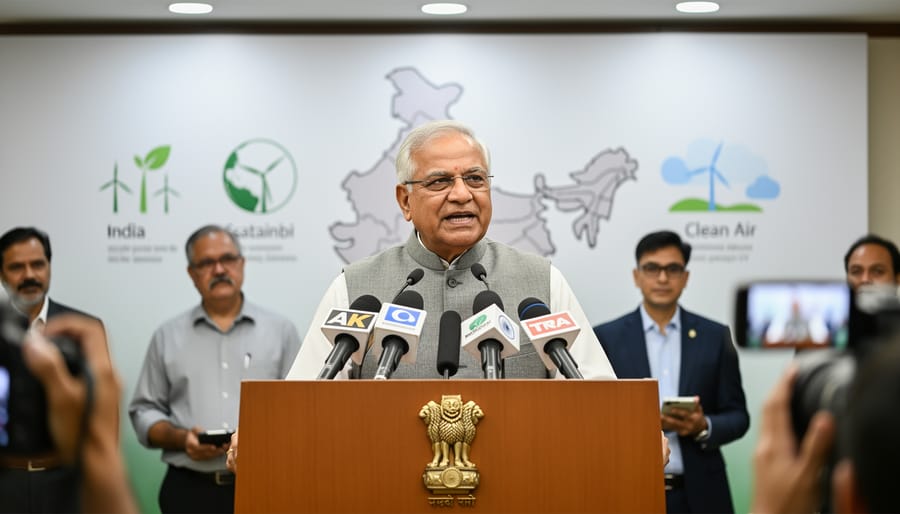
India’s Environment Minister shoulders a mandate unlike almost any other in government. The Ministry of Environment, Forest and Climate Change oversees everything from protecting the country’s remaining tiger habitats to negotiating international climate treaties that affect billions of lives. This isn’t a single-issue portfolio. It spans forest conservation across nearly a quarter of India’s land area, wildlife protection for some of the world’s most endangered species, pollution control in cities where air quality regularly hits hazardous levels, and climate policy implementation that must satisfy both global pressure and domestic development needs.
The MoEFCC official mandate includes environmental impact assessments for major infrastructure projects, meaning the minister’s office essentially holds veto power over dams, highways, mining operations, and industrial expansions. This creates constant tension between economic growth advocates and conservation priorities. The ministry also manages India’s commitments under international agreements like the Paris Climate Accord, translating global targets into enforceable national policy.
Why does this matter beyond India’s borders? With 1.4 billion people and an economy projected to become the world’s third-largest, how India balances growth with environmental protection will determine whether global climate goals remain achievable. If India can demonstrate that rapid development and environmental sustainability aren’t mutually exclusive, it offers a blueprint for dozens of other developing nations facing similar pressures. If it fails, the consequences ripple across every continent.
The minister must simultaneously satisfy farmers demanding relief from erratic monsoons, young professionals choking on urban smog, indigenous communities protecting ancestral forests, and international bodies tracking emissions targets. Few leadership positions require navigating such competing pressures with stakes this high.
India’s Unique Position in the Global Climate Conversation
India stands at one of the world’s most complex environmental crossroads. As the planet’s most populous nation and third-largest greenhouse gas emitter, it carries enormous weight in global climate negotiations. Yet this headline statistic tells only part of the story. Hundreds of millions of Indians still cook on traditional biomass fuels, and roughly 80 million people lack reliable electricity access. The Environment Minister must therefore navigate a dual mandate that few other nations face: pursuing aggressive emissions reductions while simultaneously delivering energy access that wealthier countries achieved decades ago through fossil-fuel-powered development.
This tension shapes every major policy decision. When Shri Bhupender Yadav represents India at international climate forums, he advocates for climate justice, the principle that nations which industrialized first should bear greater responsibility for emissions cuts and climate finance. India’s position challenges the developed world to acknowledge that per-capita emissions tell a different story than national totals. An average American still emits roughly eight times more carbon dioxide than an average Indian. From this perspective, asking India to curb emissions at the same pace as wealthy nations feels deeply inequitable when millions still lack basic energy services.
Yet India hasn’t used this argument as an excuse for inaction. The country has set ambitious renewable energy targets, aiming for 500 gigawatts of non-fossil capacity by 2030. This commitment matters globally because India’s energy choices will largely determine whether the world can limit warming to 1.5 degrees Celsius. The intersection of agriculture and climate adds another layer of complexity, since farming employs nearly half of India’s workforce while remaining vulnerable to climate impacts like erratic monsoons and extreme heat.
The Environment Minister’s challenge, then, is championing a development model that leapfrogs the carbon-intensive path followed by industrialized nations, proving that climate action and poverty alleviation can advance together rather than in opposition.
Recent Environmental Priorities and Policy Directions
Renewable Energy Expansion
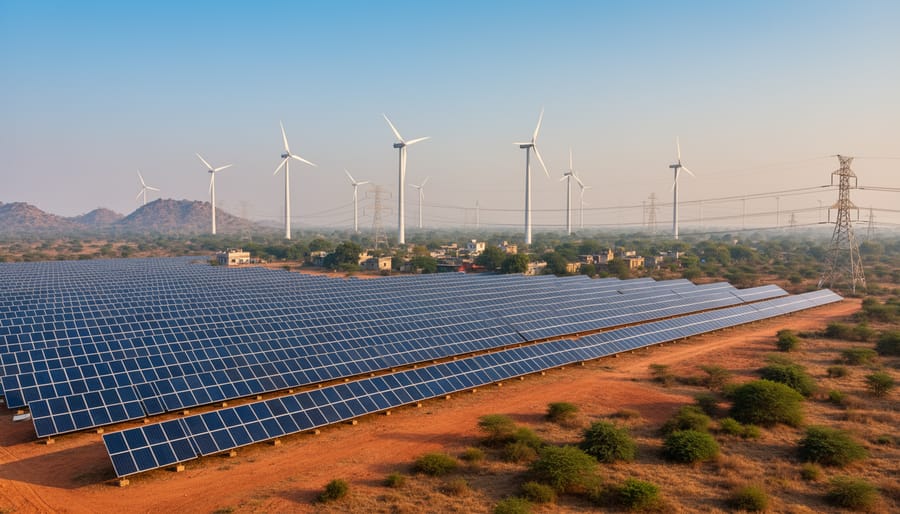
India has emerged as a renewable energy powerhouse, and the Ministry of Environment, Forest and Climate Change plays a vital role in accelerating this transition. The ministry shapes policy frameworks that make large-scale solar and wind projects economically viable while ensuring environmental standards are met throughout development.
The government’s renewable energy targets rank among the world’s most ambitious for a developing nation. By supporting streamlined environmental clearances for renewable projects and coordinating with state governments on land allocation, the ministry removes bureaucratic barriers that once slowed clean energy deployment. This approach recognizes that solar panels and wind turbines need both regulatory support and environmental oversight to scale responsibly.
Infrastructure development extends beyond power generation. The ministry works with other government bodies to establish transmission networks that connect renewable-rich regions with demand centers, addressing one of India’s biggest clean energy challenges. Policy initiatives also encourage domestic manufacturing of renewable components, creating jobs while reducing dependence on imports.
What makes India’s approach distinctive is its focus on affordability and accessibility. The ministry supports programs that bring solar power to rural communities lacking grid access, demonstrating how renewable energy can simultaneously address climate goals and energy poverty. This model shows developing nations worldwide that clean energy transitions need not wait for prosperity, they can help create it.
Balancing Conservation with Development

India’s environmental clearances process sits at the intersection of two competing imperatives: protecting irreplaceable ecosystems while enabling the infrastructure and industrial growth that hundreds of millions still need. The Environment Minister oversees a system that reviews thousands of projects annually, from highways and dams to factories and mines, determining which can proceed and under what conditions.
This balancing act shapes everything from air quality in rapidly expanding cities to the survival of tiger populations in protected forests. When clearances move too quickly, fragile habitats disappear and pollution spikes. When approvals stall indefinitely, economic opportunities vanish and communities remain without essential services like electricity and clean water.
The ministry’s approach involves environmental impact assessments, mandatory public consultations, and compensatory afforestation, requiring developers to plant trees equivalent to those removed. Recent years have seen efforts to streamline approval timelines while strengthening monitoring of compliance, a reform meant to serve both camps.
Critics argue that economic priorities too often override conservation, pointing to forest loss and wildlife corridor fragmentation. Supporters counter that India cannot freeze development while millions lack basic infrastructure. This tension isn’t going away. The minister’s challenge is crafting policies that recognize conservation and development as interdependent rather than opposed, protecting natural capital that future prosperity depends upon while meeting today’s urgent needs.
Why Young Indians Should Care About Environmental Leadership
India’s environmental policy decisions under Shri Bhupender Yadav’s ministry directly shape the professional landscape for millions of young Indians entering the workforce. The country’s commitment to renewable energy and sustainability isn’t just environmental strategy, it’s economic transformation that will define career opportunities for the next generation. When the Ministry of Environment, Forest and Climate Change sets ambitious targets for solar capacity or electric vehicle adoption, it triggers investment flows, infrastructure projects, and training programs that translate into real jobs.
The sectors growing from India’s environmental priorities offer career paths that didn’t exist a decade ago:
- Solar panel installation and maintenance technicians serving rural electrification projects
- Environmental compliance specialists helping industries meet new pollution standards
- Wildlife conservationists working on forest corridor restoration initiatives
- Green finance analysts evaluating sustainable investment opportunities
- Renewable energy engineers designing affordable clean technology solutions
- Environmental data scientists tracking climate impacts and policy effectiveness
These aren’t distant possibilities. India’s renewable energy sector already employs hundreds of thousands of workers, and projections show this number multiplying as the country pursues its clean energy goals. Young professionals entering environmental science, engineering, or policy fields position themselves at the center of India’s most significant economic transition. The minister’s policy choices determine which technologies receive support, which regions get green infrastructure investment, and which skill sets become essential.
Beyond career prospects, understanding environmental leadership matters because young Indians will live with the consequences of today’s policy decisions for decades. Engaging with how the Ministry of Environment, Forest and Climate Change balances development and conservation equips young people to contribute informed perspectives to India’s environmental future, whether through professional work, civic participation, or entrepreneurial ventures in sustainable industries.
How Environmental Policy Transcends Political Divides
India’s environmental challenges don’t respect party lines, and neither can their solutions. When coastal flooding threatens Mumbai or Delhi’s air quality reaches hazardous levels, residents across the political spectrum demand action. This shared urgency has created surprising moments of collaboration between parties that otherwise disagree on nearly everything.
The National Action Plan on Climate Change operates regardless of which coalition holds power, precisely because core environmental protections enjoy broad consensus. State governments led by different parties compete to attract renewable energy investment, recognizing that solar and wind projects create jobs and reduce energy costs for constituents. Gujarat and Tamil Nadu have both achieved significant clean energy capacity under different political leadership, demonstrating that environmental progress transcends ideology.
Forest conservation offers another example. The Joint Forest Management program involves local communities in protection efforts across states with vastly different political compositions. When the Western Ghats conservation debate emerged, politicians from multiple parties eventually supported balanced approaches that considered both ecological preservation and local livelihoods. These weren’t partisan victories but collaborative compromises that acknowledged complex realities.
This cross-party environmental cooperation matters globally because it proves climate action doesn’t require political uniformity. As cities adapting to climate impacts worldwide, India’s model shows that diverse political systems can still advance environmental goals when leaders prioritize long-term resilience over short-term positioning.
The lesson extends beyond India’s borders: environmental protection works best when treated as a shared responsibility rather than a political wedge issue. Young advocates pushing for climate action should study these bipartisan successes and replicate that collaborative spirit in their own contexts.
What Global Climate Solutions Can Learn from India
India’s environmental strategy offers a roadmap for developing nations facing the same fundamental tension: how to lift millions out of poverty while meeting climate commitments. Unlike wealthy countries that industrialized without environmental constraints, India must pursue both goals simultaneously, and the innovations emerging from this challenge carry global significance.
The country’s approach to affordable renewable technology demonstrates what’s possible when necessity drives innovation. India has driven down solar panel costs dramatically, making clean energy competitive with coal in many regions. This cost reduction benefits every developing nation, proving that climate solutions need not be luxury items reserved for wealthy economies. Community-scale solar projects in rural areas show how distributed renewable energy can reach populations that traditional grids have bypassed.
Community-based conservation represents another exportable model. India’s Joint Forest Management program involves local populations in protecting forest resources, recognizing that people who depend on these ecosystems have the strongest incentive to preserve them. This participatory approach contrasts sharply with top-down conservation that excludes communities, offering a template for other nations where poverty and environmental degradation intersect.
Perhaps most instructively, India’s climate diplomacy consistently champions the principle of “common but differentiated responsibilities”, the idea that nations should contribute to climate solutions proportionate to their historical emissions and current capacity. This framework acknowledges economic realities without abandoning climate ambition, providing political language that other developing nations can adopt. When Shri Bhupender Yadav and other leaders articulate these positions internationally, they’re building coalition space for countries that refuse to choose between development and sustainability.
India’s environmental trajectory matters far beyond its borders. As home to over a billion people navigating rapid development, India faces the defining question of our era: can a nation expand economic opportunity while meeting climate commitments? The answer shapes possibilities for every developing country.
Shri Bhupender Yadav’s Ministry of Environment, Forest and Climate Change sits at the center of this challenge, making decisions that will influence global emissions, renewable energy innovation, and environmental justice for decades. Young people worldwide should watch India’s environmental journey closely, not as distant policy but as a laboratory for solutions that bridge prosperity and sustainability.
Climate progress demands collaboration that crosses party lines and national interests. India’s environmental policies succeed when state governments, opposition parties, businesses, and communities work together toward shared goals. This model of bipartisan, inclusive climate action offers hope that we can move beyond polarization to address our collective future.
Engage with India’s environmental leadership. Learn from its innovations, understand its constraints, and recognize that your generation will determine whether climate ambition and human development can coexist. The path India charts influences the path available to us all.