
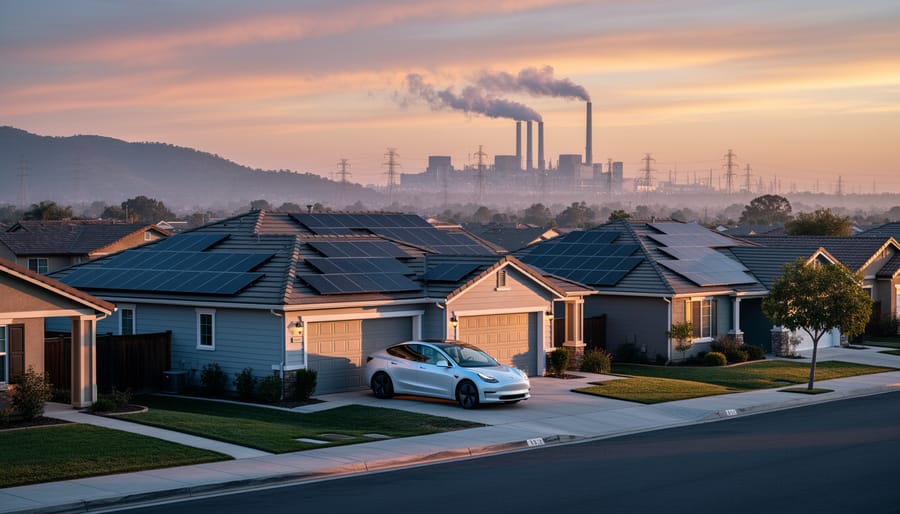

California leads the nation in solar power and electric vehicles, yet coal-fired plants in distant states still power part of our grid. This contradiction isn’t about hypocrisy. It’s about infrastructure, interstate agreements, and the complex reality of how electricity actually reaches your home.
Coal energy remains one of the world’s largest electricity sources, despite aggressive renewable targets in progressive states. The fuel that powered the Industrial Revolution now accounts for roughly 16% of electricity in the Western grid that serves California, down from over 50% two decades ago. That decline represents real progress, but the remaining coal generation carries serious consequences. Burning coal releases more carbon dioxide per unit of energy than any other fossil fuel, contributing to climate change while creating immediate health impacts through air pollution.
Young people across the political spectrum are asking the right questions. Why do we import coal power when we’ve banned it within our borders? What practical steps can accelerate the transition without destabilizing the grid or burdening working families? The answers require looking beyond California’s boundaries to regional energy systems, understanding the economic realities facing coal-dependent communities, and supporting bipartisan solutions that work for everyone.
This isn’t a story of villains and heroes. It’s about inherited systems, competing priorities, and the unglamorous work of replacing legacy infrastructure. The path forward combines technology, policy, and something often overlooked: pragmatic collaboration between people who don’t agree on everything but share a commitment to cleaner air and a stable climate.
The Numbers Behind California’s Coal Contradiction
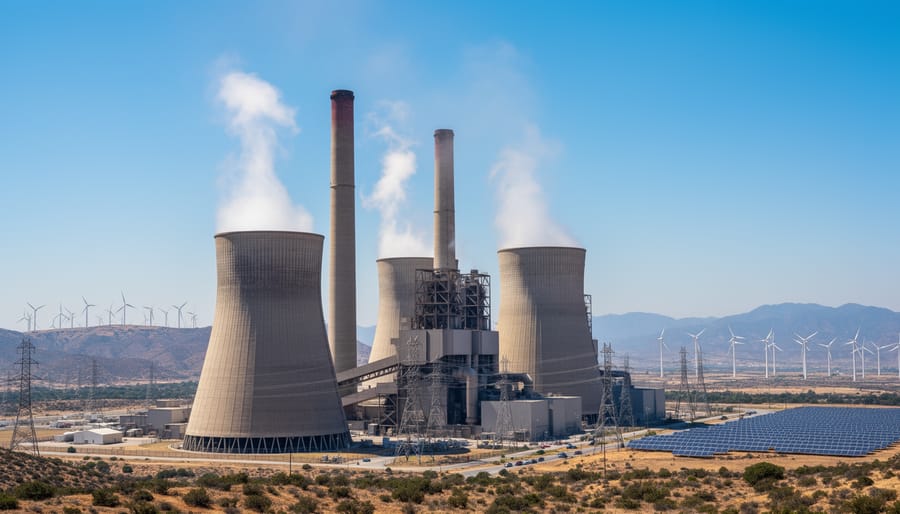
California’s coal footprint tells two contradictory stories. In 2025, coal generation was 244 GWh from just 63 MW of installed capacity. That’s a dramatic drop from the previous year, when coal was 2.2% in 2024 at 6,162 GWh.
The decline looks impressive until you do the math. California generated roughly 280,000 GWh of electricity in 2024, which means coal’s 6,162 GWh represented a small but stubborn slice of the state’s power mix. By 2025, that share shrank to less than 0.1 percent.
| Metric | 2024 | 2025 |
|---|---|---|
| Coal Generation (GWh) | 6,162 | 244 |
| Installed Coal Capacity (MW) | Not specified | 63 |
| Share of Total Generation | 2.2% | <0.1% |
Now compare that to California’s renewable buildout. Since 2019, the state has added 30,800 MW since 2019 of clean energy and storage capacity. That’s 488 times the coal capacity left operating in 2025.
The contrast is jarring. California installed more clean capacity in seven years than it would take to replace its coal infrastructure nearly 500 times over. The numbers make coal look like a rounding error, a vestige too small to matter.
But here’s the problem with those numbers: they don’t account for where California’s electricity actually comes from when the sun sets and batteries drain. The 244 GWh generated in-state captures only part of the story. The real contradiction emerges when you follow the power lines across state borders, where California’s renewable commitments run into someone else’s coal plants.
Out-of-State Coal: The Hidden Energy Pipeline
California’s coal problem extends far beyond its borders. While the state celebrated shutting down its last in-state coal plant in 2015, it continued importing coal-generated electricity from neighboring states through regional grid connections. This geographic loophole allowed California to claim clean energy leadership while still depending on coal burned hundreds of miles away.
The Intermountain Power Plant in Utah represents the most significant piece of this hidden pipeline. For decades, this massive coal facility supplied electricity directly to California through long-term contracts and transmission agreements. Los Angeles Department of Water and Power alone held a substantial ownership stake in the plant. The good news is that this major source is scheduled to stop burning coal in 2026 marking a genuine reduction in California’s coal dependency regardless of where the generation happens.
But the Intermountain plant isn’t the whole story. California’s participation in the Western electricity grid means power flows constantly across state lines based on real-time supply and demand. When California draws electricity from the regional grid during peak hours or when solar production drops at sunset, some portion of that power comes from coal plants in Arizona, Nevada, New Mexico, and Wyoming. The exact percentage varies hour by hour, making precise accounting difficult.
This geographic accounting challenge creates a transparency problem. California can report impressively low in-state coal generation while its actual consumption tells a different story. Electrons don’t carry passports. When California imports generic grid power from the Southwest, it’s purchasing a mix that includes whatever generation sources are running at that moment.
State borders complicate renewable commitments in another way too. A California utility can’t unilaterally shut down an out-of-state coal plant tied to long-term contracts negotiated decades ago. These agreements often include substantial financial penalties for early termination, creating economic barriers alongside technical ones. Breaking free requires renegotiation, contract buyouts, or simply waiting for agreements to expire.
The transition away from out-of-state coal is happening, but it demands coordination across multiple states, utilities, and regulatory bodies. It’s messier than flipping a switch, requiring the same patient infrastructure work that characterizes all aspects of the clean energy transition.
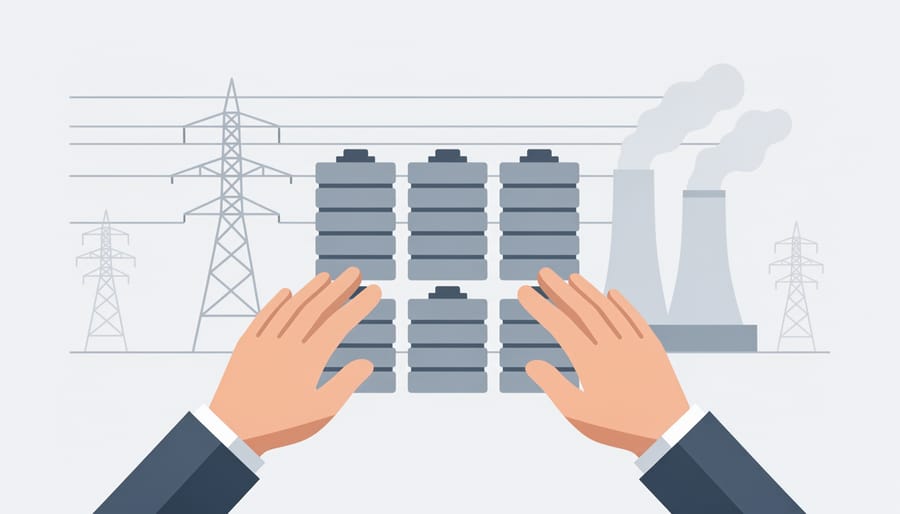
Why the Transition Takes Time (Even With Political Will)
The Reliability Challenge
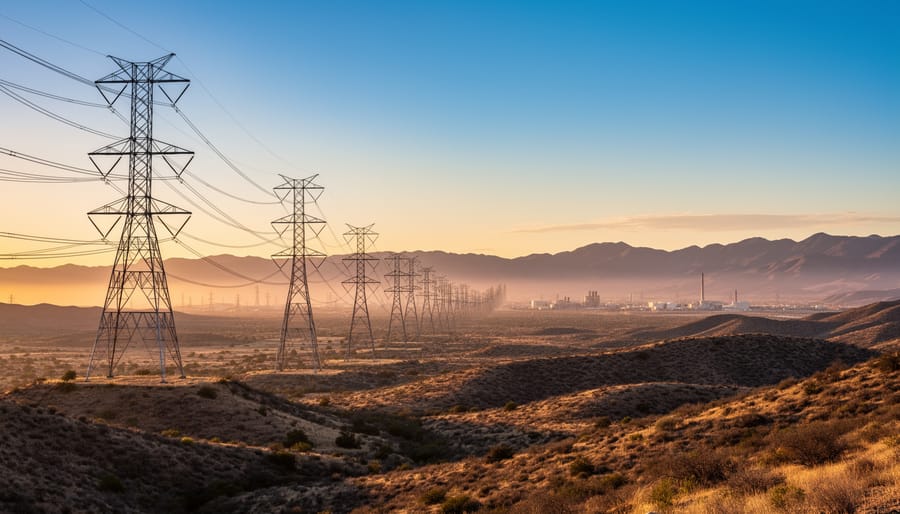
The grid stability debate is more complex than critics on either side often admit. Coal’s historical role as “baseload power” (generators that run continuously regardless of demand fluctuations) creates genuine technical challenges when phased out too quickly. Unlike solar panels that stop producing at sunset or wind turbines that slow when the breeze dies, coal plants have traditionally delivered predictable output around the clock. Grid operators need this reliability to match supply with demand every second of every day, or risk blackouts.
But framing this as an unsolvable problem ignores how rapidly battery storage technology has evolved. California’s addition of 30,800 megawatts of new clean energy and storage capacity since 2019 demonstrates that renewables plus batteries can increasingly fill the reliability role coal once played. Modern lithium-ion systems store excess solar generation during peak production hours and release it when the sun sets, effectively turning intermittent resources into dispatchable ones. Grid-scale batteries responded faster than coal plants during California’s 2020 heat wave, proving their value for both routine operations and emergency conditions.
The transition does require careful coordination. Retiring coal capacity before storage systems are fully operational creates real risks, not just theoretical concerns about air quality impacts versus grid security. Engineers must balance ambitious timelines with practical readiness, which explains why some coal contracts persist even as renewable capacity surges. The good news: storage costs have plummeted 90% over the past decade, making the economic case for batteries increasingly compelling alongside the environmental one.
Economic and Workforce Realities
Behind every megawatt of coal capacity sits a real person earning a paycheck, and that reality complicates even the most well-intentioned climate policy. The workers who operate coal plants and the communities built around these facilities face uncertain futures as the energy transition accelerates. Dismissing these concerns as obstacles to progress alienates potential allies and ignores a fundamental truth: sustainable climate solutions require sustainable livelihoods.
Just transition programs that retrain coal workers for renewable energy careers offer a practical path forward that appeals across party lines. Conservatives value economic opportunity and skilled trades, while progressives champion worker protections and environmental goals. Solar installation, wind turbine maintenance, and energy storage management create comparable middle-class jobs without requiring workers to abandon their expertise in power generation. States that invest in retraining programs and economic development in coal-dependent regions build political coalitions that accelerate rather than stall the transition.
The 30,800 megawatts of clean energy California has added since 2019 represents thousands of new jobs, but these opportunities must reach the communities coal phase-out affects most. Young people entering the workforce have a stake in ensuring transition programs deliver real results, not bureaucratic promises. When former coal workers become renewable energy advocates because the transition improved their lives, skeptics become champions. Economic justice and climate action are not competing priorities. They are inseparable components of any transition that actually works.
What Other Regions Are Getting Right
Looking beyond California’s borders reveals that rapid coal phase-out isn’t theoretical. Several regions have cracked the code, proving that ambitious timelines can work when paired with smart policy and public buy-in.
Canada stands out as a model worth studying. The country committed to phase out unabated coal-fired electricity by 2030, a deadline that once seemed impossibly tight. What made this work? Three key factors: clear regulatory timelines that gave utilities certainty for planning, substantial investment in replacement capacity before shutdowns, and targeted support for affected communities that turned potential opponents into transition partners. Provincial governments worked with coal-dependent regions on economic diversification years before plant closures, preventing the job loss panic that can derail climate initiatives.
The United Kingdom offers another instructive example. Once the birthplace of coal power, the UK went from generating 40% of its electricity from coal in 2012 to completely coal-free days by 2024. Their approach combined carbon pricing that made coal economically unviable with massive offshore wind buildout. Critically, they didn’t just replace coal megawatts with renewable megawatts. They redesigned grid operations to handle variable generation, invested heavily in interconnectors to neighboring countries for flexibility, and developed sophisticated demand-response programs.
Germany’s Energiewende, despite its challenges, demonstrates how transparent phase-out schedules reduce uncertainty. By legislating specific coal plant closure dates through 2038, Germany gave communities, workers, and utilities a roadmap. The predictability enabled long-term planning for retraining programs, new industry attraction, and infrastructure updates.
The common thread across successful transitions is that they treat coal workers and communities as partners, not casualties. Economic packages that fund new industries in coal regions, retraining initiatives that start years before closures, and pension protections for older workers address the human side that California’s approach sometimes overlooks. These aren’t just moral imperatives. They’re practical necessities that prevent political backlash from stalling progress. California can apply these lessons by establishing concrete closure timelines for remaining coal contracts, investing in affected workforce development now rather than after the fact, and building enough storage and clean firm capacity ahead of final coal retirements to avoid reliability arguments that extend coal’s life.
Bridging the Gap: A Bipartisan Path Forward
The path away from coal does not require choosing between environmental protection and economic prosperity. Both objectives align when we recognize that renewable energy creates more jobs, costs less, and strengthens energy security. Conservative voters value energy independence and economic competitiveness. Progressive voters prioritize climate action and environmental justice. These goals converge in accelerating the coal phase-out.
Economic arguments for transitioning away from coal transcend party lines. The renewable energy sector already employs more workers than fossil fuels, and job growth continues to accelerate. Solar installation technicians, wind turbine maintenance crews, and battery storage engineers earn competitive wages in communities across the country. When energy dollars stay local rather than flowing to distant coal suppliers, entire regional economies benefit. Understanding solar panel basics has become essential professional knowledge, not just environmental awareness.
Energy independence resonates across the political spectrum. Relying on coal ties us to supply chains vulnerable to market volatility and geopolitical disruption. Renewable energy, by contrast, harnesses resources that cannot be embargoed, monopolized, or subjected to foreign price manipulation. Every megawatt of solar or wind capacity installed in California reduces dependence on energy imports, whether from neighboring states or international suppliers. This argument speaks directly to voters concerned about national security and economic sovereignty.
Innovation provides another bipartisan bridge. The United States has historically led global technology revolutions, from semiconductors to the internet. Renewable energy and storage represent the next frontier where American ingenuity can dominate global markets. Companies developing advanced batteries, smart grid systems, and efficient solar cells create intellectual property and manufacturing jobs that strengthen the economy for decades. Accelerating away from coal frees resources to invest in these competitive advantages.
Young professionals entering the workforce today find more opportunities in renewable sectors than in declining coal industries. Career paths in clean energy offer stability, growth potential, and meaningful work that appeals to people across political backgrounds. This generational shift does not depend on ideology. It follows economic logic and personal ambition toward industries expanding rather than contracting.
The bipartisan path forward requires honest conversations about transition timelines, workforce support, and infrastructure investment. But the destination, a coal-free energy system, serves shared values: prosperity, independence, innovation, and stewardship. When we frame the transition around what we gain rather than what we lose, political divisions become far less relevant than collective progress.
How Young People Are Driving the Transition
Young people are no longer waiting for permission to lead the energy transition. Across California and beyond, a new generation is turning frustration with coal’s persistence into concrete action through organizing, innovation, and career choices that reshape the energy landscape.
Young climate activists are pressuring utilities and elected officials to accelerate coal phase-out timelines, often achieving policy wins that older environmental groups couldn’t secure alone. These efforts go beyond protest. Students campaigning during local and state elections have made coal retirement deadlines a voting issue, forcing candidates to take concrete positions rather than offering vague environmental platitudes.
The career pipeline is shifting just as dramatically. Engineering programs at California universities report surging enrollment in renewable energy specializations, with graduates choosing grid modernization and battery storage projects over traditional fossil fuel positions. Community colleges are expanding solar installation and wind turbine technician programs, creating pathways that don’t require four-year degrees but offer stable wages in a growth industry.
Youth-led innovation hubs are tackling the technical challenges that slow coal retirement. High school and college students are developing energy storage prototypes, writing code for smarter grid management systems, and designing community-scale renewable projects that address local reliability concerns while creating jobs.
The message from this generation is clear: understanding why coal persists matters less than building the alternatives faster. Every student who chooses renewable energy career training, every young voter who makes coal phase-out a ballot box issue, and every campus that divests from fossil fuel investments accelerates the transition. The gap between California’s renewable commitments and coal-free reality will close through this combination of advocacy pressure and workforce transformation, led by those who will live longest with the consequences of today’s energy choices.
California’s journey toward a coal-free future isn’t a story of failure. It’s a roadmap showing us exactly where to focus our energy. The state’s addition of 30,800 megawatts of clean power since 2019 proves the renewable revolution isn’t hypothetical anymore. It’s happening, it’s scalable, and it’s creating the blueprint other regions will follow.
The remaining 63 megawatts of coal capacity and the imports we still rely on aren’t permanent roadblocks. They’re the last technical and economic puzzles we’re solving in real time. Understanding why these pieces haven’t fallen into place yet gives us the leverage to accelerate their removal. Every grid reliability concern, workforce transition, and infrastructure challenge we’ve explored has an answer already in development.
Your generation holds disproportionate power in this transition. Whether you’re pursuing careers in battery technology, advocating for policy changes in your community, or simply demanding transparency about energy sources, these actions compound. The gap between California’s climate commitments and its coal-free reality will close faster because people like you refuse to accept contradictions as permanent.
The progress is real. The remaining work is clear. And the collective momentum to finish what California started is building across political lines, age groups, and industries. Understanding the paradox was step one. Eliminating it completely is the work ahead, and it’s work we can actually win.