



Canada’s federal environment minister position stands at a crossroads in June 2026, with recent ministerial transitions reshaping the country’s climate leadership at a critical moment. For young Canadians who’ve grown up with climate anxiety as a constant companion, understanding who holds this role matters less than grasping why the position itself keeps falling short of what science demands.
The minister’s office controls billions in climate funding, sets emissions regulations that touch every sector of the economy, and represents Canada in international negotiations where our credibility has taken repeated hits. Yet whoever occupies the office faces the same structural trap: being asked to deliver transformational change within a political system designed for incremental adjustments. This isn’t about partisan finger-pointing. Conservative and Liberal environment ministers alike have announced ambitious targets, only to watch implementation stall when economic concerns override ecological ones.
What makes 2026 different is timing. We’re past the point where another five-year plan can substitute for immediate action. The International Energy Agency’s latest modeling shows that countries meeting their 2030 commitments will need ministers empowered to make uncomfortable decisions now, not after the next election cycle.
For young climate advocates, this moment presents an unexpected opportunity. The ministerial transition creates space to push for accountability mechanisms that outlast any single politician’s tenure. Instead of rallying around or against whoever gets appointed, the smarter play involves demanding reforms that make the role itself more effective: binding emissions budgets with legal consequences, youth advisory councils with real authority, and transparency requirements that expose the gap between promises and policy.
The environment minister you need isn’t necessarily the one you’ll get. But the system you build around that role could matter more than any individual ever will.
The Revolving Door: A Year of Ministerial Musical Chairs
In the span of just over a year, Canada’s environment ministry has cycled through three different leaders, a revolving door that turns so fast it’s hard to keep track of who’s supposed to be steering the climate ship. Steven Guilbeault, who served until March 14, 2025 was replaced by Terry Duguid on the same day when Mark Carney was sworn in as Prime Minister. Then Duguid gave way to Julie Dabrusin, who now holds the portfolio as of 2026.
This isn’t just bureaucratic shuffling. Each transition resets relationships with provincial governments, restarts policy momentum, and forces new ministers to climb the same learning curve their predecessors just navigated. For young climate advocates who’ve spent years building connections with ministerial staff and pushing specific policy asks, each change means starting over.
| Minister | Tenure Period | Key Moments |
|---|---|---|
| Steven Guilbeault | October 2021 – March 2025 | Led Canada through COP negotiations; announced resignation from parliament May 2026 |
| Terry Duguid | March 2025 – early 2026 | Brief tenure during Carney government transition |
| Julie Dabrusin | 2026 – present | Reaffirmed 2030 climate commitments to MPs; making announcements on current policy |
The pattern reveals something deeper than normal political turnover. Guilbeault recently told a webinar that climate change has fallen lower on Canada’s political agenda, a damning admission from someone who dedicated over three years to the role. When a former minister publicly acknowledges the deprioritization happening in real time, it confirms what many young Canadians already suspected: the position itself can’t withstand shifting political winds.
Dabrusin now faces the challenge of convincing both MPs and the public that the government remains committed to its 2030 targets, despite the instability her appointment represents. She’s made announcements and addressed committees, but she’s also inheriting incomplete policy frameworks and fractured stakeholder relationships from two predecessors who barely had time to warm their chairs.
For renewable energy advocates and youth climate leaders, this instability translates to real consequences. Multi-year initiatives stall. International climate negotiations lose continuity. The institutional knowledge that should accumulate over time evaporates with each ministerial handoff. When the average tenure is measured in months rather than years, long-term climate strategy becomes nearly impossible to execute.
When Climate Falls Off the Agenda: Guilbeault’s Warning
Guilbeault’s warning came at a moment when most Canadians weren’t paying attention. During a recent webinar, the former environment minister stated plainly that climate change has slipped down Canada’s political priorities. Not “might slip” or “could decline”, has slipped. Coming from someone who spent years inside the federal machinery, this wasn’t speculation. It was a diagnosis.
For young climate activists who have organized rallies, lobbied MPs, and placed their faith in federal leadership, Guilbeault’s assessment lands differently than another politician’s platitude. This is the person who sat in cabinet meetings, who saw which issues got time and which got shelved, who understood exactly where climate ranked when competing against inflation fears, housing crises, and economic anxieties. His statement confirms what many young Canadians already suspected: the political will they’ve been fighting to build keeps evaporating.
The timing matters. Guilbeault announced his resignation from parliament on May 27, 2026, just weeks before making this blunt assessment. Without a seat to protect or a ministry to defend, he could speak freely about the structural reality. Climate action becomes optional when political winds shift. The environment minister role, no matter who occupies it, operates at the mercy of larger forces, public opinion polls, economic pressures, and the next election cycle.
What makes this particularly frustrating for youth advocates is the pattern. Current Minister Julie Dabrusin recently told MPs that the government remains committed to its 2030 climate target, using the exact language previous ministers have deployed. Yet Guilbeault’s warning suggests that commitment means less when climate isn’t driving daily political decisions. Young Canadians are left watching the same script repeat: strong words, shifting priorities, and a ministerial position too vulnerable to political pressure to force sustained action. The deprioritization Guilbeault describes isn’t a bug in the system. It’s a feature of how the role currently works.
The Structural Problem: Why This Role Keeps Failing

Caught Between Economy and Ecology
Canada’s environment ministers face an economic trap that no amount of personal dedication can solve. Every push toward emissions reduction runs headlong into the reality that fossil fuels still account for roughly 17% of Canada’s GDP and employ hundreds of thousands of workers whose livelihoods depend on extraction industries.
This creates political paralysis. Approve a new pipeline or LNG project, and climate advocates accuse you of betraying your mandate. Block it, and resource-dependent communities, industry lobbies, and provinces with oil-based economies brand you as economically reckless. The minister becomes a punching bag from all sides, unable to satisfy anyone because the expectations are fundamentally incompatible.
The impossible math shows up in every major decision. Canada committed to capping oil and gas emissions while simultaneously positioning itself as a reliable energy supplier to global markets. Ministers inherit targets set by previous administrations but lack control over the economic levers needed to meet them. Transportation policy sits with another minister. Energy development gets negotiated with provinces. Trade agreements constrain what environmental regulations can require.
This structural mismatch explains why talented people keep cycling through the role without breakthrough progress. The position demands reconciling extraction-economy realities with climate science timelines, but carries no authority to reshape the economy itself. Until that changes, environment ministers will continue managing an unsolvable equation rather than driving transformation.
Authority Without Power
Minister Dabrusin recently told a parliamentary committee that Canada remains committed to its 2030 target yet she leads a ministry that can promise everything but enforce almost nothing. The environment minister carries the political weight of Canada’s climate commitments but holds no meaningful power over the ministries actually responsible for meeting them.
Transportation accounts for roughly a quarter of Canada’s emissions, but the environment minister has no authority to mandate the shift to electric vehicles or compel transit infrastructure investments. Energy policy sits with Natural Resources. Industrial emissions fall under Innovation, Science and Economic Development. Infrastructure decisions belong to another minister entirely. When addressing climate change in cities requires coordination across municipal funding, building codes, transit planning, and land use, the environment minister becomes a cheerleader with no whistle.
This structural flaw turns every federal climate commitment into an exercise in persuasion rather than policy. The minister can set targets, announce frameworks, and attend international summits. What they can’t do is force the Transport Minister to accelerate zero-emission vehicle mandates or compel Finance to redirect fossil fuel subsidies. They request. They negotiate. They hope other ministers prioritize climate over their own political pressures.
The result is predictable: bold announcements followed by implementation gaps that no single minister has the authority to close.
What Young Climate Leaders Are Saying
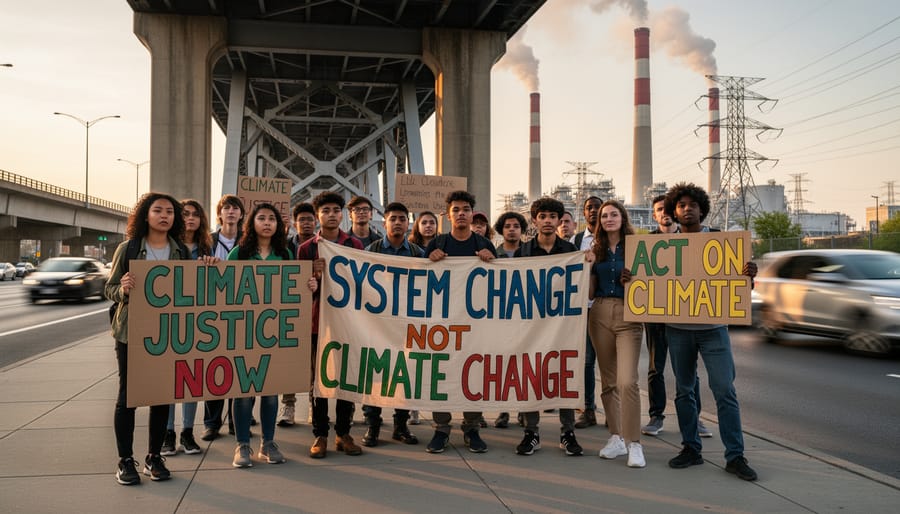
The ministerial turnover has lit a fire under Canada’s climate youth movement, but not in the way political leaders might hope. Where young climate activists once directed their energy toward pushing specific ministers to adopt stronger policies, many are now questioning whether any individual in this structurally compromised role can deliver the systemic change required.
At community organizing meetings and climate strikes across the country, young Canadians are expressing exhaustion with the cycle of hope and disappointment. When a new minister takes office, youth groups invest time rebuilding relationships, re-educating staff about urgent priorities like air quality and health impacts, and reframing arguments they’d already won with the previous administration. Then the cycle repeats.
The conversations happening in youth climate spaces reveal a maturing movement that’s moved beyond asking for better individuals to demanding institutional reform:
- Ministers need enforceable authority over other departments, not just advisory roles
- Climate commitments must survive government transitions through independent oversight bodies
- Youth representatives deserve formal seats in climate policy development, not token consultation
- Environmental decisions require transparent timelines that ministers can’t quietly delay or abandon
This shift matters because it targets the actual problem. When students campaign for climate action during elections, they’re no longer just asking politicians to care more. They’re demanding structural changes that would make it impossible for any government to quietly deprioritize climate commitments when political winds shift.
The frustration isn’t pessimism. It’s the opposite. Young climate leaders are done accepting a broken system and ready to build something that actually works for their generation and those to come.
Beyond Partisan Politics: What Actually Works
Cross-Party Climate Accountability
The UK’s Climate Change Committee offers a compelling blueprint. Established in 2008 with cross-party support, this independent body survives government transitions because it operates outside partisan control. Its mandate, setting carbon budgets and holding governments accountable, persists regardless of which party holds power. The result? Britain’s climate targets have remained legally binding through four different prime ministers and three distinct political eras.
Canada needs a similar firewall between climate science and political winds. An independent oversight body with statutory authority could set binding emissions targets based on scientific consensus rather than electoral timelines. Such a structure would prevent the deprioritization Guilbeault warned about by making climate commitments legally enforceable obligations, not ministerial preferences.
All-party parliamentary committees present another proven model. When climate accountability spans the political spectrum, individual ministers can’t quietly shelve uncomfortable targets when economic pressures mount. New Zealand’s cross-party climate framework survived coalition changes precisely because no single government could claim ownership or dismantle it unilaterally.
These structures work because they recognize a fundamental truth: climate change operates on geological timescales while political mandates last four years. Entrenching accountability beyond election cycles transforms climate action from a partisan project into a national obligation, one that survives ministerial reshuffles, priority shifts, and the political instability that has defined Canada’s environmental leadership since March 2025.
Empowering the Position
Giving the environment minister real teeth starts with budget control. Right now, the minister can set ambitious targets but has no direct authority over the billions in subsidies and investments that other departments allocate to fossil fuels or infrastructure. A reformed position would include mandatory climate budget screening, requiring Treasury Board approval to hinge on environmental impact assessments that the minister can veto. This isn’t about expanding bureaucracy; it’s about ensuring climate considerations carry weight in every spending decision.
The position also needs statutory power to compel coordination across ministries. When Transport Canada approves highway expansions or Natural Resources greenlights extraction projects, the environment minister currently offers input that can be ignored. Legislative frameworks used in countries like the UK give their climate ministers the authority to issue binding directives to other departments when policies conflict with national targets. Canada could adopt a similar model where the minister has formal sign-off authority on any federal decision with significant emissions implications.
These changes would transform the role from advisor to enforcer. Ministers would still need political skill and coalition-building, but they’d operate from a position of institutional strength rather than perpetual compromise. For young Canadians tired of watching climate commitments evaporate with each cabinet shuffle, this structural empowerment offers something more durable than good intentions: actual leverage to make things happen.
The Opportunity in This Crisis Moment
The current instability in Canada’s environment minister position is exactly the kind of crisis that creates room for transformative change. When systems visibly fail, the public appetite for fundamental reform grows, and young Canadians are uniquely positioned to demand that this role be rebuilt from the ground up, not just refilled with another well-intentioned politician.
Rather than mourning the loss of continuity, youth climate advocates can leverage this moment to push for structural changes that make climate leadership resilient to political cycles. The conversation shouldn’t be about who becomes the next minister, but what powers and accountability mechanisms that minister will have. This means advocating for cross-party climate commitments that survive cabinet shuffles, independent oversight bodies with enforcement teeth, and budget authority that allows the environment minister to actually compel other departments to align with Canada’s targets.
The economic opportunity here is massive and bipartisan. Redesigning this role to prioritize renewable energy transitions creates pathways to millions of jobs that appeal across the political spectrum. When young people understand what’s inside a solar panel or how wind turbine manufacturing works, they see careers, not just climate action. A restructured environment minister position could champion this economic transition explicitly, framing clean energy not as sacrifice but as Canada’s competitive advantage.
This moment demands that young Canadians think bigger than personnel changes. The instability we’re witnessing is a symptom of a role that was never designed to handle the scale and urgency of the climate crisis. By demanding systemic reform now, while the position is in flux and politicians are listening, the next generation can help create an institutional framework that serves their future, not the political convenience of today.
The federal environment minister role has become climate action’s biggest bottleneck because it was designed for a different era, one where environmental protection was a policy add-on rather than an existential imperative. The rapid ministerial transitions from Guilbeault to Duguid to Dabrusin in just over a year aren’t the cause of Canada’s climate inaction. They’re a symptom of a structurally broken position that sets whoever holds it up to fail.
This moment of instability is actually your opportunity. Young Canadians have the power to demand more than just another well-meaning minister appointed to an impossible role. You can push for systemic reform that makes climate leadership resilient regardless of which party holds power, cross-party accountability mechanisms, genuine enforcement authority, and budget control that survives election cycles.
The solutions exist, and they don’t require choosing sides in partisan battles. Independent climate bodies, all-party oversight committees, and empowered ministerial positions work across political divides because they serve future generations, not current electoral calculations. When Guilbeault warned that climate has slipped down Canada’s priorities, he wasn’t just commenting on politics, he was highlighting why we need institutions strong enough to resist those shifting winds.
Your generation understands what’s at stake better than any before it. The question isn’t whether Canada will fix this broken role. It’s whether you’ll settle for cosmetic changes or demand the structural transformation that actually protects your future. The institutions can be rebuilt. They’re waiting for you to insist on it.