
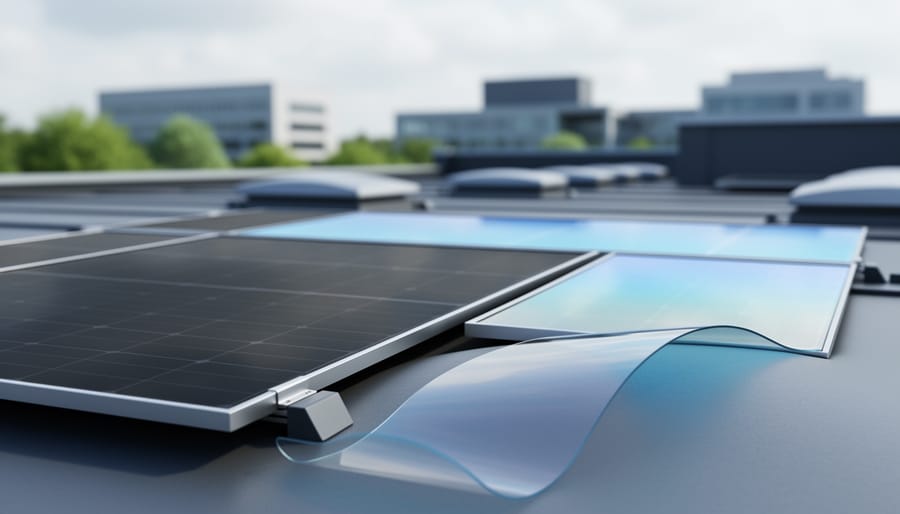

New solar panel technologies are next-generation photovoltaic systems that convert sunlight into electricity more efficiently, affordably, or flexibly than traditional silicon panels. These innovations include perovskite cells that can be printed like newspapers, tandem designs stacking multiple light-absorbing layers to capture more of the solar spectrum, and ultra-thin flexible panels that bend around curved surfaces.
The shift matters because conventional silicon panels, while reliable, have approached their theoretical efficiency ceiling at around 26%. These emerging technologies promise to break through that barrier, with some tandem cells already achieving over 33% efficiency in lab settings. More importantly, several innovations can be manufactured at lower cost or installed in places where rigid panels simply won’t work.
This guide breaks down what sets these technologies apart from the solar panels you see on rooftops today. You’ll learn how perovskite materials absorb light differently than silicon, why stacking cells can capture wavelengths that single-layer panels miss, and what makes organic photovoltaics viable for wearable devices. We’ll walk through the main categories, from bifacial panels that harvest reflected light to transparent solar windows generating power without blocking your view.
The timing couldn’t be better. Communities across the political spectrum recognize solar energy as both an economic engine and a climate solution. Young engineers and entrepreneurs are launching companies around these breakthroughs, creating jobs that didn’t exist five years ago. Understanding these technologies helps you see where the renewable energy sector is heading and how innovation continues making clean power more accessible for everyone.
What New Solar Panel Technologies Mean for Energy Innovation
When we talk about “new” solar panel technologies, we’re referring to innovations that break away from the crystalline silicon cells that have dominated rooftops and solar farms for decades. Traditional solar panels work well, they’ve powered the renewable energy revolution so far, but they have limitations in efficiency, weight, installation flexibility, and manufacturing cost. The next generation of solar technologies tackles these constraints head-on, using novel materials and designs that capture sunlight in fundamentally different ways.
These emerging innovations aren’t just incremental improvements. They represent a shift in how we think about solar energy: panels that bend around curved surfaces, transparent cells that turn windows into power generators, and ultra-thin films that weigh a fraction of conventional modules. Some achieve efficiency rates that seemed impossible just five years ago. Others promise manufacturing processes so simple and inexpensive they could make solar accessible in regions where traditional panels remain out of reach.
To understand what makes these technologies distinct, it helps to grasp a few key terms:
- Perovskite
- A class of crystalline materials with a specific atomic structure that absorbs light exceptionally well and can be manufactured using low-cost printing techniques. Perovskite cells have achieved laboratory efficiencies rivaling traditional silicon in a fraction of the development time.
- Tandem Cells
- Solar panels that stack multiple light-absorbing layers, each optimized to capture different wavelengths of sunlight, significantly boosting overall energy conversion. These designs combine materials like perovskite and silicon to achieve record-breaking efficiencies.
- Thin-Film
- Ultra-lightweight solar panels made by depositing photovoltaic materials in thin layers on flexible substrates like plastic or metal foil. They sacrifice some efficiency for versatility, portability, and applications where rigid panels can’t work.
- Bifacial
- Panels engineered to capture sunlight from both the front and back surfaces, generating additional power from light reflected off the ground or nearby structures.
The practical implications are substantial. Higher efficiency means more electricity from the same rooftop area, making solar viable for homes with limited space. Lower manufacturing costs open doors for communities and countries currently priced out of the solar market. Flexibility and transparency create entirely new use cases, think solar-powered tents for disaster relief or office buildings where every window contributes to the grid. These aren’t distant possibilities. Pilot projects and early commercial deployments are already demonstrating real-world results, creating jobs and proving that solar’s next chapter will look very different from its past.
How These Next-Generation Solar Panels Work

Perovskite Solar Cells
Perovskite solar cells use a crystal structure called perovskite, named after Russian mineralogist Lev Perovski, that absorbs light far more efficiently than traditional silicon. The material’s unique atomic arrangement allows it to capture a broader spectrum of sunlight while using thinner layers, making the cells lighter and cheaper to manufacture.
The layered structure typically sandwiches a perovskite absorber layer between electron and hole transport layers. When sunlight hits the perovskite material, it generates electron-hole pairs that separate quickly and move through these transport layers to create electrical current. This happens more efficiently than in silicon because perovskite’s crystal lattice has ideal properties for both absorbing photons and conducting charge.
Lab results have been stunning. Researchers have pushed perovskite cell efficiency past 26 percent in just over a decade, a speed of improvement that took silicon solar technology forty years to achieve. Chinese research centers have announced record perovskite efficiencies reported that rival the best commercial silicon panels available today.
The challenge remains durability. Perovskite materials degrade faster when exposed to moisture, oxygen, and heat compared to silicon. Companies are racing to solve this through protective coatings and material modifications, with some early commercial products now warranting twenty-year lifespans that approach industry standards.
Tandem and Multi-Junction Designs
Traditional silicon solar panels leave energy on the table because they can’t efficiently use the full spectrum of sunlight, they’re optimized for certain wavelengths and waste the rest as heat. Tandem and multi-junction designs solve this by stacking multiple layers of different materials, each tuned to absorb a specific range of the light spectrum.
Here’s how it works: the top layer captures high-energy blue and ultraviolet light, while lower layers absorb longer wavelengths like red and infrared that pass through. Instead of one material doing all the work inefficiently, each layer specializes in converting its portion of the spectrum into electricity. This teamwork approach dramatically boosts overall efficiency.
The most common tandem configuration pairs a perovskite layer on top of a conventional silicon cell. The perovskite handles the short wavelengths while silicon captures what filters through, effectively doubling up on energy capture from the same footprint. Lab prototypes have already surpassed 30 percent efficiency, well beyond standard silicon’s practical ceiling of around 22 percent. That means more power per panel, fewer panels needed for the same output, and lower installation costs per watt generated.
Bifacial and Transparent Solar Technologies
Bifacial solar panels feature photovoltaic cells on both their front and back surfaces, allowing them to capture direct sunlight from above while also harvesting light reflected off the ground, nearby structures, or rooftops beneath them. This dual-sided design can boost energy generation by 10-30% compared to traditional single-faced panels, depending on installation height, surface reflectivity below, and local conditions. They’re particularly effective over light-colored surfaces like white roofs or sandy terrain.
Transparent solar panels, meanwhile, use semi-transparent photovoltaic materials that allow visible light to pass through while capturing ultraviolet and infrared wavelengths for electricity generation. These panels can be integrated into windows, skylights, and glass facades, turning buildings into power generators without blocking natural light. The trade-off is efficiency: current transparent solar technologies typically convert 5-10% of sunlight into electricity, well below the 20%+ efficiency of conventional panels, because they’re designed to let much of the light through rather than absorb it.
Types of Emerging Solar Panel Technologies

Perovskite Solar Panels
Perovskite solar panels represent one of the fastest-advancing technologies in renewable energy. In just over a decade, lab efficiencies have soared from around 3% to over 33% in tandem configurations, a pace that took silicon panels nearly 40 years to achieve. This rapid progress stems from perovskite’s unique crystal structure, which absorbs sunlight exceptionally well across a broad spectrum while remaining relatively simple to manufacture.
Unlike traditional silicon panels that require energy-intensive, high-temperature processing, perovskite cells can be produced using solution-based techniques at lower temperatures. This could dramatically reduce manufacturing costs and energy consumption, making solar power more affordable and accessible.
However, significant hurdles remain before widespread adoption. Perovskite materials degrade when exposed to moisture, heat, and UV light, conditions every outdoor solar panel must withstand for 25-plus years. Researchers are testing protective coatings and more stable formulations, but no commercial perovskite panel yet matches silicon’s proven longevity. Scaling from small lab cells to full-size panels while maintaining efficiency also presents manufacturing challenges that companies are actively working to solve.
Tandem Solar Cells
Tandem solar cells stack two or more light-absorbing layers on top of each other, with each layer tuned to capture different parts of the sunlight spectrum. A silicon bottom layer absorbs red and infrared wavelengths efficiently, while a perovskite top layer grabs the blue and green light that silicon typically wastes. This pairing lets a single panel harvest far more energy from the same sunlight than either material could alone.
Laboratory tandem cells have broken efficiency records repeatedly, pushing past 33 percent compared to around 26 percent for top-tier silicon-only panels. Several manufacturers now have commercial prototypes in field testing. The main technical hurdle is ensuring both layers remain stable and perform well over decades outdoors.
Early tandem installations focus on utility-scale solar farms and specialized applications where higher efficiency justifies the current premium cost. As production scales up and prices drop, these combination panels could become standard, delivering more power per square foot and making solar viable in space-constrained settings.
Organic and Flexible Photovoltaics
Organic photovoltaics use carbon-based materials instead of silicon to convert sunlight into electricity. These solar films are remarkably thin and flexible, picture a solar panel you can roll up like a poster or integrate into curved surfaces. The technology works by using layers of organic compounds that absorb light and generate electrical current, though currently at lower efficiencies (10-15%) than rigid panels.
The real advantage is versatility. Manufacturers can print these films using roll-to-roll processes similar to newspaper printing, dramatically reducing production costs and energy. They’re lightweight enough for backpacks, tents, and emergency shelters. You’ll find them in portable phone chargers, temporary event installations, and architectural applications where traditional panels won’t work, like curved building facades or vehicle surfaces. While they degrade faster than silicon panels, ongoing research is improving their lifespan and making them viable for short-term or mobile applications where rigidity isn’t practical.
Bifacial and Building-Integrated Designs
Bifacial panels flip the script on traditional solar by capturing sunlight from both their front and back surfaces. Mounted on reflective surfaces or elevated racks, these panels harvest direct sunlight on top and reflected or scattered light underneath, boosting total energy output by 10-30% compared to single-sided panels in the right conditions. They’re particularly effective in snowy environments, near water, or over white rooftops where light bounces back strongly.
Building-integrated photovoltaics take a different approach entirely: instead of adding panels to a structure, the solar technology becomes part of the building itself. Solar windows use semi-transparent photovoltaic materials that let some light through while generating electricity, ideal for office towers and skyscrapers where traditional rooftop space is limited. Solar facades and cladding replace conventional exterior materials with energy-generating surfaces, and solar roof tiles integrate seamlessly into residential architecture without the look of bolted-on panels.
These designs solve a persistent challenge in urban areas: limited space. By turning existing building surfaces into power generators, they expand solar’s reach into dense cities where rooftop real estate is scarce or unavailable.
How New Solar Technologies Are Being Used Today

Residential and Commercial Buildings
Homeowners can now pilot perovskite-silicon tandem panels through select installers, gaining efficiency boosts of 25-30% compared to traditional rooftop systems, meaning more power from the same square footage. Building-integrated photovoltaics (BIPV) are appearing in commercial projects as solar windows, façade panels, and roofing tiles that generate electricity while serving structural roles. These installations reduce material costs and preserve aesthetics, making solar viable in urban settings where rooftop space is limited. Early adopters report payback periods shortening as technology costs decline and federal incentives expand. The shift matters beyond individual savings: widespread residential and commercial adoption creates local installation jobs, sparks demand for electricians and engineers trained in next-generation systems, and supports the broader infrastructure needed for cities adapting to renewable energy grids. As manufacturers scale production, expect these technologies to move from pilot programs to mainstream options within a few years.
Utility-Scale Projects and Grid Integration
At the utility scale, new solar technologies are transforming what’s possible in large-scale renewable energy generation. Solar farms deploying tandem cells and bifacial panels now produce substantially more electricity per acre than traditional installations, making projects financially viable in regions where land costs or available space previously posed barriers.
Bifacial panels, which capture sunlight from both sides, perform especially well in utility settings where ground reflection can be optimized through reflective surfaces or light-colored gravel beneath arrays. This dual-sided generation boosts total output by 10 to 20 percent without requiring additional land.
High-efficiency perovskite-silicon tandem cells are entering pilot deployment at utility scale, promising power generation gains that improve project economics and grid contribution. As these cells reach commercial maturity, utilities can generate more clean energy from existing infrastructure and transmission capacity, accelerating the replacement of fossil fuel sources.
Grid integration benefits extend beyond raw power output. Because many new solar technologies maintain efficiency in diffuse light or low-sun conditions, they deliver more consistent generation throughout the day, reducing the intermittency challenges that complicate renewable energy planning. This reliability makes clean energy more dependable for grid operators managing diverse power sources across multiple states.
Specialized and Emerging Markets
Flexible and lightweight solar technologies are opening doors in niche markets where traditional panels fall short. Automakers and researchers, including the MIT solar EV team, are embedding thin-film cells into vehicle roofs and hoods to extend driving range, while charging stations use bifacial panels to maximize power capture in tight urban spaces. Portable solar devices, from foldable chargers to solar-powered medical kits, now reach disaster zones and humanitarian operations where grid access is nonexistent. Remote communities are pairing off-grid solar systems with next-generation panels to reduce installation costs and maintenance trips. These specialized uses demonstrate how new solar technologies create economic opportunities in transportation, emergency response, and energy access, sectors that benefit directly from lighter, more adaptable designs. The integration of solar in EVs alone could spark job growth across manufacturing, installation, and fleet management as adoption scales.
Why These Innovations Matter for Climate and Economy
These technological leaps matter because they directly address why climate change demands urgent action while proving that solving it creates economic wins, not sacrifices. Higher-efficiency panels mean more clean energy generated per acre, per rooftop, per dollar invested, accelerating the replacement of fossil fuels without requiring impossible amounts of land or capital. When perovskite tandems push past 30% efficiency or bifacial designs capture light that traditional panels waste, every solar farm produces more power, every home installation cuts deeper into carbon emissions, and renewable energy becomes the cheapest, most practical choice for more people and businesses.
Lower manufacturing costs turn these gains into widespread adoption. As new materials and production methods drive prices down, solar moves from a premium option to the default energy source for new construction, retrofits, and grid expansions. Communities that couldn’t justify traditional solar suddenly have affordable pathways to energy independence. Rural cooperatives, schools, and municipal buildings can invest in systems that pay back faster and last longer, keeping energy dollars local instead of flowing to distant utilities.
The economic opportunity is enormous and bipartisan. Manufacturing these next-generation panels creates factory jobs in towns across political divides. Installation, maintenance, and integration work employs electricians, roofers, and engineers at scale. Research and development hubs attract talent to regions hungry for high-tech industries. Young people entering the workforce find careers that didn’t exist five years ago, designing flexible solar films, optimizing tandem cell production, integrating transparent panels into skyscrapers, or managing solar microgrids in underserved communities.
This isn’t just environmental progress; it’s a jobs engine that rewards innovation, strengthens energy security, and proves climate action drives prosperity. When new solar technologies deliver cheaper power, create employment, and slash emissions simultaneously, the climate fight becomes an economic win everyone can support.

Common Questions About New Solar Panel Technologies
Can you actually get these new solar panels today, or are they still confined to research labs? What will they cost, and how do they hold up over time? These are the questions on everyone’s mind as headlines tout the latest breakthroughs in solar technology.
The reality is nuanced. Some innovations, like bifacial panels and certain building-integrated products, are commercially available right now through specialized installers and manufacturers. You can order them, get quotes, and have them installed. Perovskite and tandem cells, despite their impressive lab results, remain largely in pilot programs and limited production runs as of 2026. A handful of companies have begun small-scale commercial offerings, but widespread availability is still a few years out for most consumers.
Are new solar panel technologies available to buy now?
Bifacial and some building-integrated solar products are commercially available through select manufacturers and installers. Perovskite and tandem cells are in pilot and early commercial stages, with limited availability expected to expand over the next few years.
How much do these new technologies cost compared to traditional panels?
Bifacial panels typically cost 10-20% more than standard silicon panels upfront, though they generate more power. Emerging technologies like perovskite are expected to become cost-competitive or cheaper once scaled, but early commercial versions may carry premium pricing.
Are they as durable as conventional solar panels?
Traditional silicon panels carry 25-30 year warranties and proven longevity. Newer technologies like perovskite are still proving their durability in real-world conditions, with researchers working to match that lifespan through improved encapsulation and materials.
Can I add new solar technologies to my existing system?
In most cases, yes, if the voltage and inverter specifications match. Bifacial panels and other silicon-based innovations integrate readily with standard residential systems, while more experimental technologies may require consultation with your installer.
Environmental impact is another common concern. Manufacturing any solar panel requires energy and materials, but emerging technologies often promise lower resource intensity. Perovskite cells, for instance, can be produced at lower temperatures than silicon, potentially reducing manufacturing emissions. The full lifecycle analysis is still being refined as production scales, but the direction points toward cleaner manufacturing processes.
Choosing the right technology comes down to your specific situation. If you’re installing solar today and want proven performance, traditional or bifacial silicon panels make sense. If you’re drawn to cutting-edge efficiency and willing to work with newer products that may have shorter track records, tandem cells entering the market could be worth exploring. For building-integrated applications, windows, facades, unique architectural elements, transparent or flexible options open possibilities that weren’t feasible before.
The key is asking the right questions of installers: What warranty coverage exists? How does the technology perform in your climate? What’s the expected payback period compared to conventional options? Are there local incentives that make emerging technologies more affordable? A reputable installer will walk you through trade-offs honestly rather than overselling the latest trend.
New solar panel technologies represent more than incremental improvements, they’re opening pathways to faster, more affordable renewable energy adoption. Perovskite cells, tandem designs, flexible photovoltaics, and building-integrated systems are pushing the boundaries of what solar can achieve, making clean energy accessible in places and applications that traditional panels couldn’t reach. These innovations aren’t just about higher efficiency numbers in a lab; they’re translating into real jobs, economic growth, and practical climate solutions that work for communities across the political spectrum.
For young people concerned about climate change, this is your field. The solar industry is expanding rapidly, and these emerging technologies are creating career opportunities in research, manufacturing, installation, and policy. You don’t need to wait for someone else to drive the transition, whether you’re interested in engineering, business, advocacy, or trades, there’s a role for you in shaping how these technologies deploy.
Stay curious. Follow the developments, ask questions about cost and reliability, and hold decision-makers accountable for supporting clean energy innovation. Climate action isn’t a partisan issue when it creates jobs, lowers energy costs, and builds resilient communities. The next generation of solar technology is here, and the next generation of energy leaders should be too. Get involved, stay informed, and help turn these breakthroughs into lasting change.