
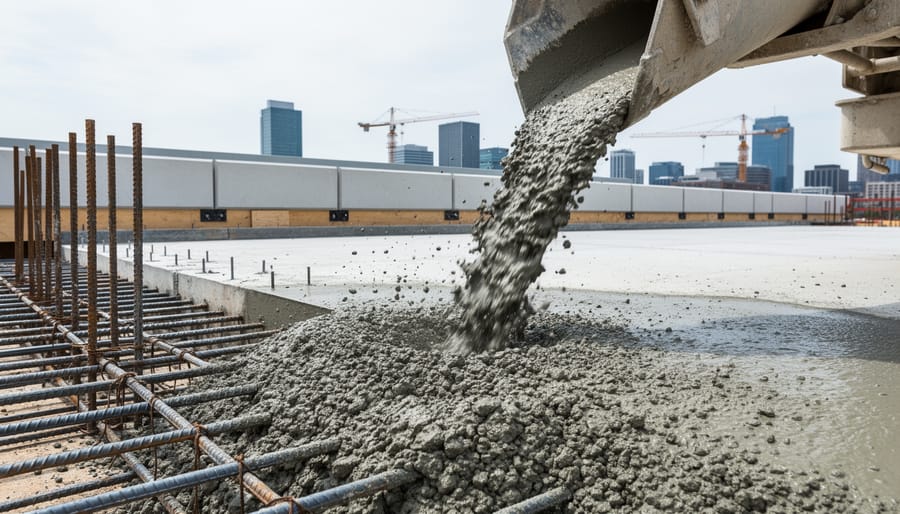

Concrete construction is the process of building structures using concrete, a composite material made from cement, water, and aggregates like sand and gravel. From sidewalks and bridges to skyscrapers and dams, concrete shapes nearly every aspect of our built environment and stands as the second most-consumed material on Earth after water.
If you care about climate change, concrete construction demands your attention. The cement industry alone accounts for roughly 8% of global carbon dioxide emissions, more than the entire aviation sector. Every ton of cement produced releases approximately one ton of CO2 into the atmosphere, making concrete both an indispensable building material and a significant climate challenge.
But here’s what makes this topic different from many environmental discussions: solutions are already taking shape, and they’re happening across the political spectrum. Innovators are developing low-carbon concrete mixtures, engineers are designing structures that use less material without sacrificing strength, and policymakers from both sides are supporting breakthroughs in green cement technology. Young professionals entering architecture, engineering, and construction fields today have unprecedented opportunities to reshape how we build.
This article will walk you through what concrete construction actually involves, how the process works from mixing to curing, the different types of concrete and construction methods available, and where concrete gets used most. You’ll then explore why concrete’s carbon footprint matters, what the latest innovations are doing to address it, and how you can contribute to building a more sustainable future, whether you’re considering a career in construction or simply want to understand the materials shaping our world.
What Concrete Construction Really Means
Concrete construction is the process of building structures using concrete, a composite material made by combining cement, water, sand, gravel, and other additives that hardens into a rock-like mass. It’s both the material itself and the entire workflow of mixing, transporting, pouring, shaping, and curing that material into the roads, buildings, bridges, and foundations that define our modern world. Unlike wood or steel construction, concrete starts as a liquid that can be molded into almost any shape before it sets, which is why you’ll find it everywhere from basement floors to skyscraper cores to hydroelectric dams.
What makes concrete so dominant isn’t just its versatility. It’s incredibly durable, fire-resistant, and relatively inexpensive compared to alternatives. These qualities have made concrete most-used after water among all manufactured materials on Earth. We produce roughly 10 billion tons of it globally each year. That staggering volume means concrete construction shapes the physical environment more than any other industrial process.
Understanding a few key terms helps clarify what concrete construction actually involves:
- Concrete vs. Cement
- Cement is the powder that acts as the glue; concrete is the final mixture of cement, water, and aggregates. You can’t build with cement alone.
- Aggregate
- The sand and gravel that make up 60-80% of concrete’s volume, providing bulk and strength while reducing the amount of cement needed.
- Reinforced Concrete
- Concrete with steel bars or mesh embedded inside, combining concrete’s compression strength with steel’s tensile strength to handle bending and stretching forces.
- Formwork
- Temporary molds or frames that hold wet concrete in place until it hardens into the desired shape.
- Curing
- The controlled process of keeping concrete moist and at the right temperature while it gains strength, typically taking 28 days to reach full hardness.
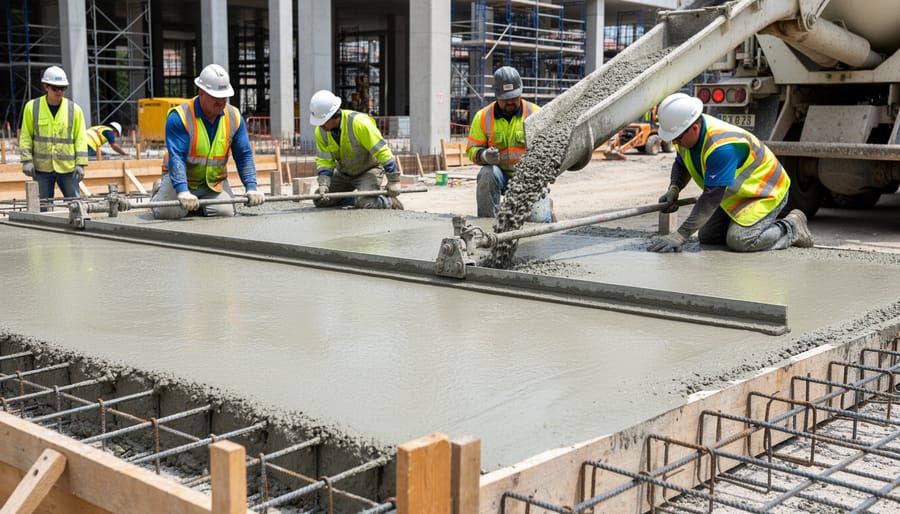
When you see a construction site pouring concrete, you’re watching a material system and a building method rolled into one. That wet gray slurry will become a permanent piece of infrastructure, and the choices made during that process determine not just the structure’s performance but also its environmental footprint.
How Concrete Construction Works
The Role of Cement in Concrete
Cement acts as concrete’s glue, binding together sand, gravel, and water into the rock-hard material we see in sidewalks and skyscrapers. It makes up only 10 to 15 percent of a typical concrete mixture by volume, but it’s responsible for the overwhelming majority of concrete’s carbon footprint.
Manufacturing cement requires heating limestone and clay to extreme temperatures, around 1,450 degrees Celsius, in massive kilns. This process releases CO2 in two ways. First, burning fossil fuels to generate that intense heat produces emissions. Second, and more significantly, the chemical reaction itself releases carbon dioxide trapped in the limestone. For every ton of cement produced, roughly 0.9 tons of CO2 enter the atmosphere.
Because cement production is so energy-intensive and chemically carbon-heavy, even small improvements in how we make or use cement can have outsized climate benefits. That single ingredient drives most of the environmental impact we’ll explore later, which is why innovations in cement chemistry and manufacturing represent some of the most promising pathways to greener concrete construction.
Mixing Ratios and Material Components
Concrete is surprisingly simple in theory: cement, water, aggregates (sand and gravel), and sometimes chemical admixtures. But the ratios matter enormously.
A typical mix might be one part cement, two parts sand, three parts gravel, and half a part water. Stronger concrete needs more cement relative to aggregates. High-rise buildings demand different proportions than sidewalks. Engineers tweak these ratios to balance strength, workability, and cost.
Here’s where the environmental footprint enters. Cement is the carbon-intensive villain, producing one ton of cement releases roughly 900 kilograms of CO2. So every percentage point of cement you can replace with lower-carbon alternatives or recycled materials cuts emissions. Water ratios affect curing and durability: too much weakens the concrete, leading to earlier replacement and more resource use over time.
Admixtures, chemicals that improve flow, speed curing, or enhance durability, can reduce the cement needed for a given strength. Fly ash or slag can partially replace cement without sacrificing performance, slashing the carbon footprint. Optimizing these proportions isn’t just engineering; it’s climate action built into every batch.
Different Types of Concrete Construction
Traditional vs. Modern Techniques
Traditional concrete construction methods have dominated for over a century, relying on standardized mixing ratios, extensive formwork, and consistent curing periods. Contractors would order ready-mix concrete in predetermined volumes, often oversupplying to avoid shortfalls, a practice that generates substantial waste. Conventional formwork systems use timber or steel that requires significant labor to assemble and dismantle, and standard curing involves continuous water application over days or weeks.
Modern techniques flip this script by prioritizing precision and resource efficiency. Digital tools now calculate exact concrete volumes needed for each pour, reducing over-ordering by up to 20%. Self-compacting concrete eliminates the need for mechanical vibration, cutting labor time and energy use during placement. Advanced formwork systems made from modular, reusable materials slash waste and speed up construction timelines.
Perhaps most significant: 3D printing technology and prefabrication are reshaping how we build with concrete. Robotic systems deposit concrete layer by layer, using only what’s needed for the structure and eliminating formwork entirely in some applications. Factory-built precast elements arrive on-site ready to install, improving quality control while reducing transportation emissions through consolidated deliveries.
These innovations aren’t just environmentally smarter, they’re often faster and cheaper once implemented. Early adopters report project timelines cut by 30% while meeting stricter sustainability standards, proving that modern methods create both environmental and economic wins.
Where Concrete Construction Is Used Today
Concrete construction shapes virtually every environment where people live, work, and move. From the foundation of your apartment building to the highway you drive on, concrete forms the literal backbone of modern civilization. Understanding where it’s used reveals both the scale of the challenge and the enormous opportunity for climate impact.
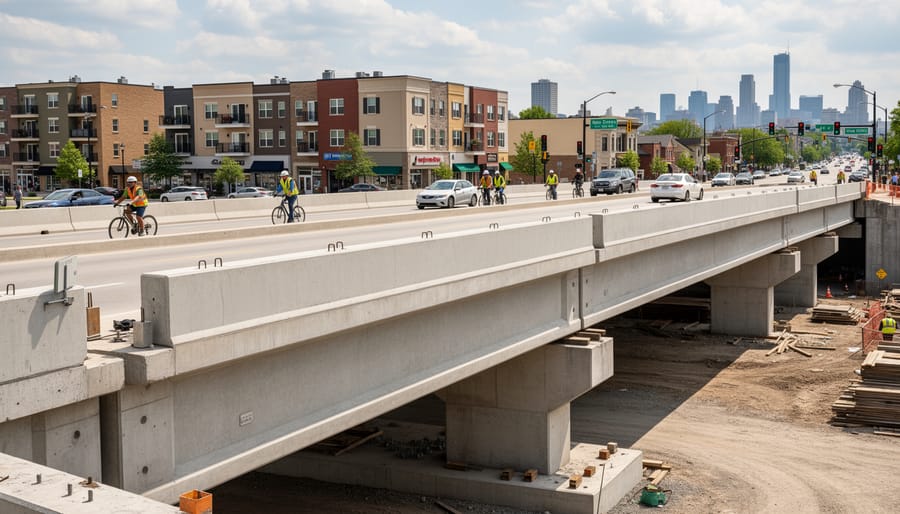
Infrastructure represents the most visible and voluminous application of concrete construction. Roads, bridges, tunnels, dams, and airports rely almost entirely on concrete for durability and load-bearing capacity. The interstate highway system alone contains billions of tons of concrete, while major dams like Hoover Dam used enough concrete to pave a highway from New York to San Francisco. Water treatment facilities, sewage systems, and stormwater management infrastructure, essential for public health and increasingly critical as cities adapting to climate change, depend on concrete’s resistance to water and chemical exposure.
The residential and commercial building sectors consume enormous quantities of concrete. Foundations, basement walls, driveways, and increasingly entire structural frames use concrete for fire resistance, energy efficiency, and longevity. High-rise buildings in urban centers rely on reinforced concrete cores and floor slabs, while suburban development sprawls across concrete foundations and roads. Shopping centers, office parks, warehouses, and parking structures, the infrastructure of daily commerce, are predominantly concrete.
Industrial applications extend concrete’s reach even further. Manufacturing plants need heavy-duty floors to support machinery and withstand chemical spills. Energy infrastructure, from nuclear containment structures to wind turbine foundations, requires concrete’s strength and stability. Even renewable energy projects, solar farms and hydroelectric facilities, depend on concrete foundations and support structures.
This ubiquity means concrete construction isn’t optional or easily replaced in the near term. It means that greening concrete represents a leverage point for climate action that touches nearly every sector of the economy and every community on the planet.
The Climate Impact of Concrete Production
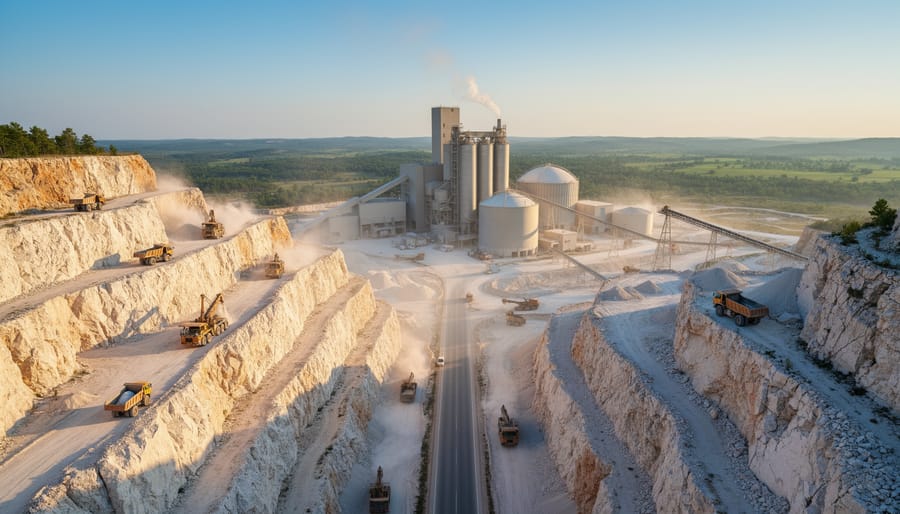
Concrete production sits among the root causes of climate change accounting for roughly 8% of global carbon dioxide emissions. That’s more than the entire aviation industry. To understand why such a seemingly simple material carries such weight in our climate equation, we need to look at what happens inside cement plants.
The carbon problem starts with chemistry, not just energy use. Cement manufacturing requires heating limestone (calcium carbonate) to extreme temperatures, around 1,450 degrees Celsius, in massive rotating kilns. This heat breaks limestone down into lime (calcium oxide) and releases CO2 as a chemical byproduct. This process, called calcination, is unavoidable with traditional cement production and accounts for about 60% of cement’s carbon emissions. The limestone itself gives up its carbon, regardless of how the kiln is heated.
The remaining 40% comes from the fuel burned to reach those scorching temperatures. Historically, coal powered most cement kilns, though natural gas and alternative fuels have made inroads in some regions. Either way, massive amounts of energy are required, adding another substantial emissions burden.
Here’s the scale that matters: the world produces over 4 billion tons of cement annually. When you multiply that volume by the dual carbon sources, chemical and thermal, you get emissions comparable to those of major industrialized nations. And since cement is the essential binding ingredient in concrete, every foundation poured and highway built carries this carbon legacy.
The connection between production and construction is direct. More building activity means more cement demand, which means more kiln operations running continuously. Infrastructure booms in developing nations and aging systems needing replacement in developed countries keep demand climbing. The construction industry can’t simply stop using concrete, which makes addressing these emissions both urgent and complex.
Beyond climate, cement production contributes to air pollution with health impacts for communities near manufacturing plants. Particulate matter, nitrogen oxides, and sulfur compounds affect air quality and respiratory health, disproportionately affecting frontline communities.
The good news? This massive emissions source represents an equally massive opportunity for innovation and impact, which we’ll explore next.
Solutions Emerging Across the Industry
The Role of Policy and Industry Leadership
Government policy and industry leadership are converging to accelerate the transformation of concrete construction. This isn’t a story of regulation versus business, it’s collaborative problem-solving driven by economic opportunity and climate necessity.
Federal infrastructure legislation passed with bipartisan support has allocated billions for low-carbon construction materials, creating market certainty that encourages innovation. Programs like the Federal Highway Administration’s Climate Challenge reward state departments of transportation for using lower-emission concrete, effectively pulling new technologies into mainstream use. Buy Clean initiatives require government projects to prioritize materials with transparent, reduced carbon footprints, giving first-mover companies a competitive advantage.
Industry coalitions are moving even faster than mandates require. The Concrete Sustainability Council and similar groups have established voluntary certification systems that measure and verify emissions reductions across the supply chain. Major cement manufacturers have pledged to achieve carbon neutrality by 2050, with interim targets driving immediate investments in cleaner kilns, alternative fuels, and carbon capture technology.
Market demand amplifies these efforts. Developers pursuing LEED certification and corporate tenants with sustainability goals are specifying low-carbon concrete in contracts, turning environmental performance into a business requirement. When the world’s largest construction projects, from data centers to transit systems, demand cleaner materials, the entire industry responds.
This three-way alignment of policy, industry leadership, and market forces creates momentum that individual actions alone couldn’t achieve. The concrete sector is proving that climate solutions can advance through pragmatic collaboration rather than partisan gridlock.
What Young People Can Do
You don’t need a construction management degree to make a difference in how we build. The concrete industry is hiring right now, engineers, materials scientists, sustainability coordinators, and project managers who understand both the technical side and the climate imperative. Community colleges and universities are launching programs in green construction and sustainable materials, fields that didn’t exist a decade ago. These aren’t niche careers; they’re the future of a $1.4 trillion global industry that needs fresh thinking.
Beyond careers, your voice shapes policy. Show up at city council meetings when building codes are updated. Support green building standards in your municipality. Write to representatives about infrastructure bills that fund low-carbon concrete research and deployment. This isn’t partisan, both sides recognize that upgrading our infrastructure creates jobs and modernizes essential systems. When you explain climate change to younger siblings or friends, include concrete in the conversation. Most people have no idea that the sidewalk under their feet has a carbon footprint, and that awareness drives consumer pressure.
Vote with your wallet, too. Research which construction firms in your area use low-carbon concrete or recycled aggregates. If you’re renovating or building, ask contractors about sustainable options. Developers respond to market signals faster than you’d think. Share stories about concrete innovation on social media, not doom-scrolling content, but the breakthroughs happening in labs and on job sites. The industry is changing because people demand it. Your generation’s expectations will define what gets built next, and how.
Common Questions About Concrete and Climate
Is replacing concrete entirely realistic, or do we need to work with what we have? Can the industry truly decarbonize, and what will it cost? These are fair questions, especially for anyone trying to understand how we balance infrastructure needs with climate goals.
Can we replace concrete entirely with more sustainable materials?
Not realistically. Wood, steel, and other alternatives work for some applications, but concrete’s combination of strength, durability, versatility, and cost makes it irreplaceable for most infrastructure. The focus should be on making concrete sustainable rather than eliminating it.
Is green concrete more expensive than traditional concrete?
Currently, many low-carbon alternatives cost 10-30% more, but prices are dropping as production scales up. In some cases, optimized mix designs that use less cement can actually reduce costs while cutting emissions.
How quickly can the concrete industry realistically decarbonize?
Experts estimate the industry could cut emissions by 40-50% by 2030 using existing technologies, with full decarbonization possible by 2050 if innovation continues and policy support remains strong. The pace depends heavily on investment and regulatory frameworks.
What single change would make the biggest difference?
Switching to low-carbon cement alternatives would have the largest immediate impact, since cement production accounts for roughly 90% of concrete’s carbon footprint. Even partial substitution with materials like fly ash or calcined clay creates significant emissions reductions.
The timeline question matters because change won’t happen overnight. Cement plants are massive industrial facilities with decades-long lifespans, so retrofitting or replacing them takes time and capital. That said, progress is accelerating faster than many predicted even five years ago. Major producers have committed to net-zero targets, and pilot projects using carbon capture or alternative chemistries are moving from lab to market.
Cost remains a sticking point, but it’s important to view it through the right lens. Yes, sustainable concrete often carries a premium today. But that gap narrows when you factor in the long-term costs of climate damage, the health impacts of pollution from traditional cement plants, and the potential for carbon pricing to shift economic incentives. Government procurement policies that prioritize low-carbon materials can also drive demand and bring prices down through scale.
The question of whether concrete can ever be truly sustainable depends on how you define the term. Will it match the carbon footprint of timber? No. But concrete made with alternative binders, recycled aggregates, captured carbon, and renewable energy in production can approach carbon neutrality. Some experimental concretes even absorb CO2 over their lifetime, though these remain niche. The goal isn’t perfection but continuous improvement paired with smarter use, building only what we need, designing for longevity, and planning for end-of-life reuse.
Concrete construction isn’t going anywhere. It’s the backbone of our roads, schools, hospitals, and homes, infrastructure that connects communities and powers daily life. But here’s the good news: this industry doesn’t have to remain a climate problem. The transformation is already happening, driven by innovation, investment, and people who refuse to accept the status quo.
Across party lines, leaders recognize that rebuilding America’s infrastructure creates jobs while addressing climate challenges. Low-carbon cement, recycled materials, and smarter construction methods aren’t radical ideas, they’re practical solutions with bipartisan support. When Republicans and Democrats agree on infrastructure investments, we get real momentum for change.
Young people hold enormous power in this transition. Whether you’re considering a career in engineering, advocating for green building codes in your community, or simply asking questions about the materials in your school’s new gym, you’re part of the solution. Every conversation, every career choice, and every vote shapes how quickly this industry evolves.
The concrete beneath our feet can become a foundation for a sustainable future. We have the technology, the economic incentive, and the political will. What we need now is action, your action. The industry that built the modern world can rebuild it better, cleaner, and stronger. That work starts with people like you deciding it matters.